
Invoicing Agent
Eliminates manual billing steps, accelerates cash flow, and surfaces payment leaks.
Begin with a M.A.P.P.™ Studio Session that maps your workflows, data, bottlenecks, and highest-value agent opportunities into a clear AI blueprint before deployment.
Every founder, operator, and agency owner feels the same pressure: competitors move with smarter systems while manual work clogs the people best equipped to grow the business.
You have likely invested in tools, platforms, and agencies, but growth still feels slower than it should. The team remains stretched thin while opportunities slip through operating gaps.
That gap is not a lack of ambition. It is disconnected infrastructure. Rigid software and brittle automations slow down under complexity; governed agents change the operating model.
Markets are shifting faster than most teams can respond. Prospects expect personalized engagement quickly, customers expect support without delays, and leaders expect growth without ballooning payroll.
Eliminates manual billing steps, accelerates cash flow, and surfaces payment leaks.
Produces branded, ready-to-send proposals quickly so sales teams can stay focused on deals.
Enriches leads and supports consistent outreach while the team focuses on qualified conversations.
The approved offer source describes dozens of hours spent each week across these tasks. Multiply that same pattern across coordinated agent workflows: the objective is not simply saving time. It is generating revenue, protecting attention, and turning complexity into clarity.
SourceYou have seen frameworks and acronyms. Ours is simple: SAIAS™ — Streamline, Automate, Integrate, Accelerate, Scale.
Before you add more, cut the noise. We start by mapping your stack and identifying redundancies. Most companies are running three CRMs, two project managers, and a patchwork of automations that barely hold together.
Tools alone will not create leverage. Agents do more than execute a script: they observe signals, decide within defined guardrails, and act — like adding a specialized teammate for each bottleneck. Because they run consistently in the background, that leverage compounds without stacking repetitive work on the team.
Lock teams into rigid workflows.
Break when the context becomes complex.
Cannot scale every repetitive task indefinitely.
Monitors pipeline velocity and escalates deals that remain stuck too long.
Drafts campaigns, tests variations, and prepares them for deployment.
Reconciles payment, CRM, and accounting records without repetitive handoffs.
Monitors competitor activity and surfaces meaningful offer changes.
Operates inside defined guardrails for the workflow your team actually uses.
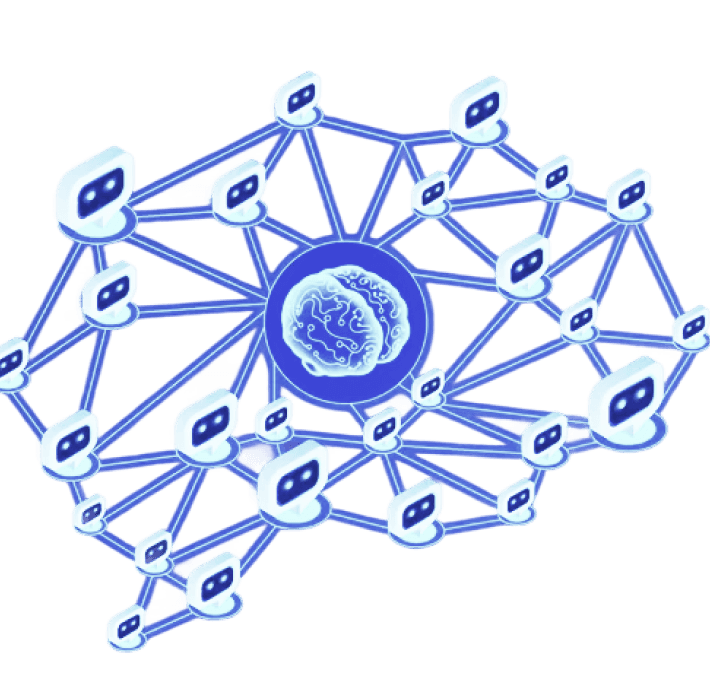
A parent agent coordinates research, performance, script, and hook specialists. Rough notes become feed-ready posts using current web findings, brand context, proven patterns, and a curated opener library.
The four-stage deployment path shows what working with agents actually looks like — from a precise audit to live agents operating inside the business.
We don’t start by throwing automations at the wall. We start with precision.
Outcome: A clear picture of what’s slowing the business down and which levers to automate first.
SourceOnce we know what matters most, we design targeted agents to address those bottlenecks.
Outcome: Each agent is sandboxed and tested before deployment.
SourceAgents by themselves are powerful. Agents working together create the operating leverage.
Outcome: Performance is monitored and behavior is tuned against real workflow conditions.
SourceOnce the foundation is in place, we layer in advanced agents.
Outcome: The company moves from reactive firefighting to proactive scaling.
SourceTeams arrive with the same friction: bloated stacks, repetitive work, slow sales cycles, and opportunities slipping through cracks. The approved offer source documents what changed when agents stepped into those exact workflows.

An Operations Agent reconciles payments, flags chargebacks, and synchronizes commerce and accounting records. The offer source reports a 60% reduction in accounting overhead.
ESTIMATE — NOT VERIFIED · SourceA Revenue Agent monitors pipeline velocity and surfaces stagnant deals. The offer source reports a 15% increase in deal conversion within the first quarter.
ESTIMATE — NOT VERIFIED · SourceA Campaign Agent generates and tests ad-copy variations across channels. Use measured click-through and cost-per-lead results as evaluation inputs.
ESTIMATE — NOT VERIFIED · SourceA Proposal Agent drafts and formats proposals in under 60 seconds. The offer source reports a 27% close-rate increase because prospects received documents faster.
ESTIMATE — NOT VERIFIED · SourceIf you are here, you already see the shift. You may have tested general-purpose assistants or workflow tools and found the same limitation: activity without a connected operating system.
You need intelligence built into workflows, customization aligned to the business model, and scale without stacking more people or more tools.
The solution is a connected agent system across every business function — not another set of disconnected tools. Each agent is trained for a defined workflow, integrated into the current stack, and scaled with clear guardrails.

Every agent receives the context, permissions, approval rules, and recovery path required for its business function.
Here is where the engagement becomes concrete. The existing offer provides an entry build for validation, a core package for scale, a full transformation, and division-scale work.
Adoption, existing automations, recovery, cost, and model routing should be resolved before deployment — not after it.
Once agents are live, they run in the background. Operators use a clear command view for performance, exceptions, and decisions without adding another complicated software tool.
Traditional workflows connect and trigger steps. Agents observe signals, prioritize within guardrails, and escalate the moments that matter.
Agents include retry logic, fallback routes, reporting, and monitoring. Exceptions become visible instead of silently stopping the workflow.
The right comparison is the cost of missed deals, unsent proposals, delayed campaigns, and repeated manual work. The engagement is mapped to measurable operating gaps before deployment.
Model work is routed by task so premium reasoning is used where it matters and lighter execution is used where it preserves quality at lower cost.
Seeing isolated agents is one thing. Seeing them stitched together across lead capture, revenue, delivery, and reporting is where the operating model becomes real.
Reported outcome: sales-cycle time cut in half and close rate increased by 27%.
ESTIMATE — NOT VERIFIED · Source
Reported outcome: recovery rate increased by 38% and operating overhead decreased by 60%.
ESTIMATE — NOT VERIFIED · Source
Reported outcome: onboarding moved from 14 days to 3 days.
ESTIMATE — NOT VERIFIED · Source
The distinction is not louder claims. It is a repeatable deployment framework, deep stack integration, visible operator controls, and evidence linked to the approved source.
SAIAS is a repeatable path from noisy systems to focused deployment.
Nearly 2,000 workflows are documented as candidates for customization.
The system combines orchestration tools and custom development instead of forcing every workflow through one platform.
The offer source documents more than a decade across automation, marketing systems, and scale engineering.
The operating model is built to support organizations from startups through multi-division teams.
The M.A.P.P.™ Studio Session turns your current stack, bottlenecks, constraints, and growth priorities into a clear AI blueprint with the best first deployment sequence.
Reserve My M.A.P.P.™ Session